 travee+
Ramayana Yatra Fixed Departure Ex Lucknow
Ayodhya & Janakpur
Overview
An 11-day fixed-departure pilgrimage tracing important places associated with the Ramayana across North India and Nepal. Starting from Lucknow, the journey covers Naimisharanya, Ayodhya, Prayagraj, Chitrakoot, Varanasi, Buxar, Patna, Janakpur, Sitamarhi and Gaya, concluding with Pind Daan rituals at the Falgu River.
Itinerary
Arrive in Lucknow, the regal City of Nawabs, known for its rich heritage, refined culture, and delectable cuisine. Upon arrival, check in to your hotel and relax after your journey. Depending on your arrival time, you may take a leisurely evening stroll through the colonial-era lanes of Hazratganj, explore local markets for Chikankari embroidery and handicrafts, or enjoy a traditional Awadhi dinner at a renowned local restaurant. Return to your hotel for a comfortable overnight stay in Lucknow, soaking in the charm and grace of this historic city.
Your journey begins with the arrival in either Ayodhya or Lucknow, both holding their unique allure. In Ayodhya, you'll step into the sacred realm, resonating with the divine as it's hailed as the birthplace of Lord Rama in Hinduism. Upon arrival, settle into your chosen accommodation. The evening unfolds with leisure at your fingertips, offering an opportunity for personal exploration. As the night falls, rest and rejuvenate for the days of exploration that lie ahead, ensuring you're ready to embrace the journey's unfolding experiences. - Rama Janmbhoomi Ram Janmabhoomi is the birthplace of Rama, believed to be the seventh avatar of Vishnu. The Ramayana states that the location of Rama's birthplace is on the banks of the Sarayu river.
Today marks the transition from Ayodhya to Prayagraj, formerly known as Allahabad, renowned for its convergence of three sacred rivers at the Triveni Sangam. Embark on a scenic journey that takes you from the spiritual ambiance of Ayodhya to the historical richness of Prayagraj. Upon arrival, immerse yourself in the sacred atmosphere as you visit the Sangam Triveni, where the Ganges, Yamuna, and Saraswati rivers meet, offering a moment of profound spiritual significance. Explore the iconic landmarks of Allahabad, including the majestic Allahabad Fort and the historic Anand Bhavan, each holding tales of bygone eras and significant events in India's history. As the evening unfolds, soak in the cultural heritage and architectural marvels that grace the cityscape before retiring for the night in Prayagraj, where the essence of spirituality and history intertwine seamlessly. - Shringverpur • Shringverpur is a village in Lucknow that is 35kms from Prayagraj. • It is the capital of the kingdom Nishadraj also known to have been the place of residence of Shringi Rishi. • This is one of the places where Lord Rama stayed for a night during his exile. - Triveni Sangam Triveni Sangam is the convergence of river Ganges, Yamuna, and Saraswati. Located in Prayagraj, 174 kilometers away from our previous destination Ayodhya. Yamuna and Ganga can be recognized through their different colors - the Yamuna is greenish in color and the water of Ganges is clear white while Saraswati is known to be invisible. The auspiciousness of this Sangam is mentioned in the Rigveda, which says "Those who bathe at the place where the two rivers, white and dark, flow together, rise up to heaven. - Veni Madhav Temple The Veni Madhav Temple, one of the 12 temples of Lord Madhav (Dwadasha Madhav temples) is situated in Prayag. It is located in Daraganj. This is a Shaligram Vigraha that is mentioned in various Puranas and was also visited by Sri Chaitanya Mahaprabhu. - Bade Hanuman Temple The Hanuman temple, also known as Lete Hanuman Mandir houses the huge Hanuman deity. This is the only Hanuman temple in which the deity is in a reclining position. It is said that the water of the Ganges first touches Lord Hanuman and then flows down. The entry of water into the temple brings welfare to Prayag. - Akshayat Akshayvat in Prayagraj is a sacred banyan tree located at the Prayagraj fort. It stands on the banks of river Yamuna, next to the sangam. As per the Valmiki Ramayana when Lord Rama visited Bhadwaja Muni's ashram, the sage had told Lord Rama that if he sees Akshayvat tree in prayagraj on his way to chitrakoot, he can be assured that he is on the right path.
After an early breakfast in Prayagraj, proceed to the sacred town of Chitrakoot. On arrival, check in to your hotel and relax. Later, begin exploring this divine destination associated with the exile years of Lord Rama. End your day in the peaceful spiritual ambiance and return to your hotel for an overnight stay in Chitrakoot. - Gupt Godavari Located at a distance of about 18 km from the district of Chitrakoot, it is the sight of Lord Rama and Lord Laxmana's stay during their exile for 14 years. - Sati Anusnya Ashram Located about 18 km from Ramghat, it is a part of the "Chitrakoot Char Dham". ORIGIN OF THE NAME: It served as the ashram of Maharishi Atri along with his wife Mahasati Anasuya- one of the Mahasatis in holy scriptures of Hinduism because of her devout, pure and chaste character. - Sphatik Shila Situated on the banks of River Mandakini, The Sphatik Shila is in fact two enormous boulders which contain the footprints of Lord Rama and Goddess Sita. It is also the place from where they enjoyed the beauty of Chitrakoot.
Begin your day by visiting the leftover sacred sites of Chitrakoot, completing your spiritual exploration of this divine land. Began your drive to Varanasi. On arrival in Varanasi, check in to your hotel and relax for the night, preparing for the next chapter of your spiritual journey. - Kamadgiri Parvat • Meaning of 'kamad giri' is the mountain which fulfills the desires and wishes of all. • Lord Kamtanath is the principal deity of Chitrakoot. • It is also the site where Lord Brahma performed the first yagna before the creation of life (shristi). • The place where Lord Rama, Mata Sita, and Lakshman stayed during their exile of 14 years. A pilgrimage path envelops this hill, whose distance is about 6 km approx. Performing the parikrama takes around 3-4 hours. - Ram Ghat • Located on the banks of Mandakini River, It is the site where Lord Rama, Goddess Sita, and Lord Laxman held an elaborate conversation with Saint Goswami Tulsidas. • The ghat offers boating facilities to the tourists, and you can find these boats lining the steps leading to the river. • A massive statue of Lord Hanuman stands in one corner of the ghat, blessing everyone who visits it. • A Large number of people start gathering at Ram Ghat from dawn. - Bharat Milap Temple • ORIGIN OF NAME: It is served as the site where Lord Bharat met Lord Rama. • Located in close proximity to this temple is another temple built in honor of Mandavi, the wife of Lord Bharata. - Bharat Koop Located near the village of Bharatpur, the place is about 20km West of Chitrakoot. It houses an enormous well - Bharat Koop! - Ram Darshan • Located close to River Mandakini, the deities of Lord Rama, Goddess Sita, and Lord Hanuman reside at this temple. • A giant statue of Lord Hanuman occupies the entrance and blesses visitors at the entrance. Also present are sculptures of Goswami Tulsidas and Maharshi Valmiki. • There is a complete prohibition on puja and offerings. The temple showcases an artistic depiction of various events from Ramayana. The various episodes are depicted in the form of statues, carvings, and paintings. - Ganesh Bhag • Located on the Karvi-Devangana Road, it is a place of both aesthetic and historical significance. The main attractios of this place are the temple, palace and the step well. The temple complex contains a massive stepwell (known as Baoli in the native language) • The palace which stands here was built during 19th century by the Maratha ruler, Peshwa Vinayak Rao, and maintained by the archeological survey of India. • This structure is believed to have served as the summer resort of the royal family. Also present is a temple dedicvated to Lord Shiva, with arched gateways and pillars.
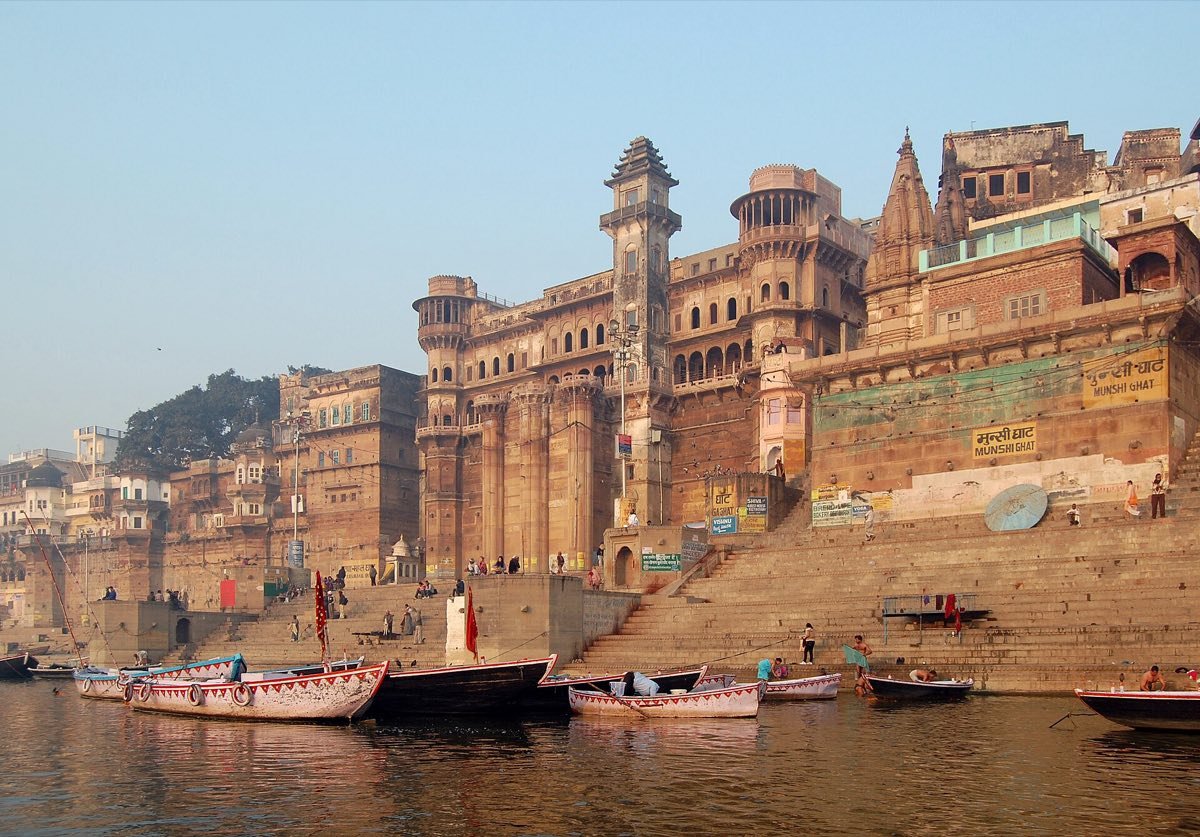
Begin your day with a morning tour of Varanasi's revered temples, each offering a glimpse into the city's profound spiritual heritage. Visit Assi Ghat along with other prominent ghats, witnessing the daily life and rituals along the sacred Ganges River. Dive into Varanasi's vibrant markets, renowned for their exquisite silk and handcrafted items, capturing the essence of local artistry and culture. As the day comes to a close, settle in for an overnight stay in Varanasi, reflecting on the rich experiences and discoveries of the day. - Annapurna Temple Triveni Sangam is the convergence of river Ganges, Yamuna, and Parvati stole her fair complexion (Gauri form). She asked Shiva for his help to reacquire her Gauri form. Shiva asked her to donate anna (food) in Varanasi. Hence, she took the form of Annapurna (the goddess of food) with a golden pot and ladle, and donated food in Varanasi. - Kaal Bhairav Mandir Kaal Bhairav Mandir (Hindi: काल भैरव मंदिर) is one of the oldest Shiva temples in Varanasi, India. Situated in Bharonath, Vishweshwarganj (Varanasi), this temple has great historical and cultural importance in Hinduism; especially amongst the locals. - Bindu Madhav Temple According to a saga in Kashi Khand (mentioned in Kashi Vishnu Yatra) when Lord Vishnu evicted King Divodasa from his Kingdom he established himself in the form of Adi Keshav at Padodak teerth. Thereafter, Lord Vishnu when reached Panchnad Teerth he got infatuated with the glory of Kashi. - Tulsi Manas Temple One of the famous Hindu epics, Ramayan was originally written in Sanskrit language by Sanskrit poet Valmiki between 500 and 100 BC. Being in Sanskrit language, this epic was not accessible to and understood by masses. - Sankat Mochan Hanuman Temple Besides the Assi river stream, on the way of Durga Temple to Banaras Hindu Temple this well known temple of Lord Hanuman is situated. This temple is founded by Goswami Tulsidas. This temple is also known as "Monkey" temple, as lot of monkeys are there inside the premises. Uniqueness of temple one can notice themselves once entered to temple. There is abundance of monkeys. On Hanuman Jayanti which comes in month of April one big procession is taken out. Devotees in disguise of Lord Hanuman perform all the acts related to legends of Lord Hanuman. - Ganga Aarti Out of the all spiritual places in Varanasi, you must visit Dashashwamedh Ghat for Ganga Aarti and Assi Ghat for Subah-E-Banaras. At Dashashwamedh ghat, one moment there's hustle-bustle about finding the perfect place to watch the aarti, and the other moment the entire city falls silent when a shankh (conch) is blown. The shankh heralds that the aarti is beginning and it draws everyone's attention. Since the Ganga aarti of Banaras is for the River Ganga, a statue of Goddess Ganga is placed in the centre at one of the many raised platforms.
After an early breakfast, set out from Varanasi for Patna, a road journey of about 270 km that takes nearly 6–7 hours. Buxar, a town steeped in history and mythology. Here, you can explore the ancient Buxar Fort, offering scenic views of the Ganga, and visit the sacred Ram Rekha Ghat, believed to be associated with Lord Rama’s exile. Visit Siddhashram & Tadka Temple (Tataka was killed here, Rishi Vishvamitra took Rama & Lakshman at Buxar) After sightseeing in Buxar, continue the onward drive of about 150 km towards Patna, passing through fertile plains and rural landscapes that showcase the heart of Bihar. On reaching Patna by evening, check into your hotel and unwind. If time permits, you may take a short city tour, visiting attractions such as the iconic Golghar, the historic Gandhi Maidan, or attend the soulful Ganga Aarti at Gandhi Ghat. Overnight stay will be in Patna, wrapping up a day that blends spirituality, history, and culture.
Drive from Patna to Janakpur in Nepal, traditionally regarded as the birthplace of Sita Devi and the location of her marriage to Lord Rama. Complete the required India–Nepal border formalities and visit Janaki Mandir and Vivah Mandap. Valid travel documents must be carried as per prevailing regulations.
Depart from Janakpur after breakfast and cross back into India through the border checkpost; immigration formalities take some time. Stop at Sitamarhi, traditionally associated with the discovery of Sita Devi by King Janaka while ploughing the field. Visit Panoura Dham and the Sitamarhi Temple before continuing south across the Gandak plains to Patna. Check in at the hotel on arrival. Overnight in Patna.
After breakfast, drive to Gaya, an important destination for ancestral rituals and moksha traditions. On arrival, visit the Vishnupad Temple on the bank of the Falgu river and Sita Kund across the river. Continue to Bodh Gaya, where Gautama Buddha attained enlightenment, and explore the Mahabodhi Temple complex with the Bodhi tree and other sacred sites according to available time. Check in at the hotel and overnight in Gaya.
On the final day, perform Pind Daan at the Falgu River or another designated ritual site in Gaya, following local religious procedures. The ritual is associated with Lord Rama's offerings for his father, King Dasharatha. After completing the ceremony and receiving blessings, proceed to the railway station, airport or confirmed onward departure point. Priest and ritual-material charges should be confirmed separately.
Where you sleep
Hover any hotel to see what we know about it. Pick the grade that suits you; the price moves with it.
Price per person, by group size
In INR, per person, hotels on twin sharing at the grade you pick. A planner confirms the exact price for your dates.
| Group | Standard | Deluxe | Premium | Luxury |
|---|---|---|---|---|
| 2 travellers Private air-conditioned vehicle | 49,900 | 53,900 | 63,900 | 84,800 |
| 4 travellers Private air-conditioned vehicle | 45,900 | 49,600 | 58,800 | 78,000 |
| 6 travellers Private air-conditioned vehicle | 42,400 | 45,800 | 54,300 | 72,100 |
What's included
✓ Included
- Ten nights' accommodation in deluxe hotels on sharing basis.
- Daily breakfast and dinner.
- Private air-conditioned vehicle for the complete Ramayana Yatra.
- Vehicle toll taxes, parking charges and driver expenses.
- Complete Ramayana Circuit sightseeing and temple darshan according to the itinerary.
- Applicable taxes and service charges stated as included in the source.
✗ Not included
- Airfare and railway tickets.
- India–Nepal border documentation costs, permits or taxes if separately applicable.
- Lunch, snacks and beverages.
- VIP darshan, special pooja and ritual charges.
- Pind Daan priest fees and ritual materials.
- Boat-ride charges unless expressly confirmed as included.
- Temple, monument and attraction entrance fees not expressly included.
- Laundry, tips, porterage and personal expenses.
- Travel, medical, accident and personal insurance.
- Expenses arising from weather, road closure, border delay, traffic or other unforeseen events.
- Any service not specifically mentioned in the inclusions.
Terms & conditions
Cancellation Policy
- If cancellation is done before 30 days of arrival, 90% of the total booking amount will be refunded.
- If cancellation is done before 25-30 days of arrival, 70% of the total booking amount will be refunded.
- If cancellation is done before 20-24 days of arrival, 50% of the total booking amount will be refunded.
- If cancellation is done before 10-19 days of arrival, 25% of the total booking amount will be refunded.
- If cancellation is done within 09 days of arrival, 00% of the total booking amount will be refunded.
Payment Policy & Schedule
- 25% of the tour package cost needs to be deposited at the booking time.
- Next 50% of the tour package cost should be deposited at least 30 days before the actual date of departure.
- The remaining 25% (complete 100%) should be deposited at least 15 days before the date of actual departure.
Important Notes
- The rates do not apply to peak festive time and season.
- Rates of accommodation depend on availability; if the mentioned hotels are unavailable, alternate stays of the same class/category will be arranged.
- Most hotels have a 12:00 noon check-in / check-out. Early / late check-in is subject to availability.
- Vehicle air-conditioning runs on plain roads only and is normally switched off on hill drives.
- Sightseeing is subject to political, traffic and weather conditions and may change when conditions are extremely adverse.
- Entrance / temple fees are to be paid directly by the client at the venue.
- We advise against travelling at night; supplement charges will apply when necessary.
You may also like
More tours: India tour packages · Uttar Pradesh tour packages
 Pilgrimage
Ayodhya, Prayagraj, Varanasi & Gaya Tour
7 Nights / 8 Days · Uttar Pradesh
PilgrimageAwadh Triangle Tour
5 Nights / 6 Days · Uttar Pradesh
PilgrimageAwadh Weekend Tour
4 Nights / 5 Days · Uttar Pradesh
PilgrimageVaranasi & Prayagraj Yatra
3 Nights / 4 Days · Uttar Pradesh
